
Summary
Role
Sr. Strategic Design Lead
I led product strategy and experience design for core creation workflows, shaping how users build and iterate on digital experiences.
Product
AI-powered SaaS platform enabling enterprise teams to design, deploy, and scale intelligent workflows.
Scope
End-to-end ownership of key product workflows, from content creation to iteration and publishing, defining interaction patterns and improving usability across design and prototyping systems.
Timeline
10 weeks (including discovery, iteration, and alignment)
Team
• Product Manager
• Engineers
• Data Scientist
Impact & Success Indicators
$5M+
estimated influence on product investment decisions
35%
estimated workflow efficiency improvement
• Faster alignment across Product, Engineering, and Data Science teams, fostering better collaboration
• Developed scalable patterns embraced across various teams, making processes smoother
• Boosted stakeholder confidence in the direction of AI-driven products, inspiring more trust and support
Key Decisions & Tradeoffs
Opted for human-in-the-loop workflows over full automation to increase trust, enable oversight, and support high-stakes decision-making.
Used progressive disclosure instead of simplifying away complexity to balance usability with transparency and improve confidence in AI outputs.
Balanced speed with accuracy by introducing confidence indicators, allowing users to act quickly while understanding the reliability of insights.
Prioritized end-to-end workflows over feature expansion to reduce cognitive load and help users move from insight to action more efficiently.
Designed AI as a system-level capability rather than a standalone feature to create a cohesive, scalable experience across the product ecosystem.
Built reusable AI interaction patterns with configurable flexibility to support consistency across products while adapting to different use cases.
Background
Enterprise organizations were rapidly investing in AI, but product teams lacked a clear way to translate complex models into usable, scalable experiences.
At IBM, I led design for a new AI-powered SaaS initiative aimed at helping internal teams operationalize machine learning capabilities across multiple products. The opportunity represented a $10M+ strategic investment, but success depended on aligning technical complexity with real user needs.
Challenge
The core challenge wasn’t just designing an interface, it was defining how AI should function within a product ecosystem.
Key details:
• AI capabilities were technically viable but not usable
Workflows were fragmented across tools, creating high cognitive load
Stakeholders had conflicting visions of how AI should be applied
No existing pattern for agentic or AI-assisted workflows
Building powerful AI features that users wouldn’t trust or adopt
Approach
1. Framing the Right Problem
I led cross-functional discovery sessions with Product, Engineering, and Data Science to shift the conversation from:
“What can the model do?” → “What decisions do users need to make?”
This reframed AI as a decision-support system and not just a feature.
2. User & Workflow Research
Conducted stakeholder and user interviews across technical and non-technical roles
Mapped end-to-end workflows to identify breakdowns in decision-making
Identified key pain points:
Lack of transparency in AI outputs
Low confidence in model recommendations
Inefficient handoffs between teams
3. Defining Experience Principles
I established core principles to guide design:
Clarity over complexity
Guidance over automation
Trust through transparency
These principles aligned teams and reduced ambiguity in product direction.
4. Iteration & Prototyping
Rapidly prototyped multiple interaction models for AI-assisted workflows
Tested concepts with users to evaluate:
Trust in AI outputs
Comprehension of system behavior
Iterated toward a model that balanced:
Automation
Human control
Explainability
Solution
I designed a scalable framework for AI-powered, agent-assisted workflows that:
Translated complex model outputs into actionable user insights
Introduced progressive disclosure, allowing users to explore AI reasoning
Enabled users to guide, refine, and override AI decisions
Established reusable patterns for integrating AI across multiple products
Key Deliverables
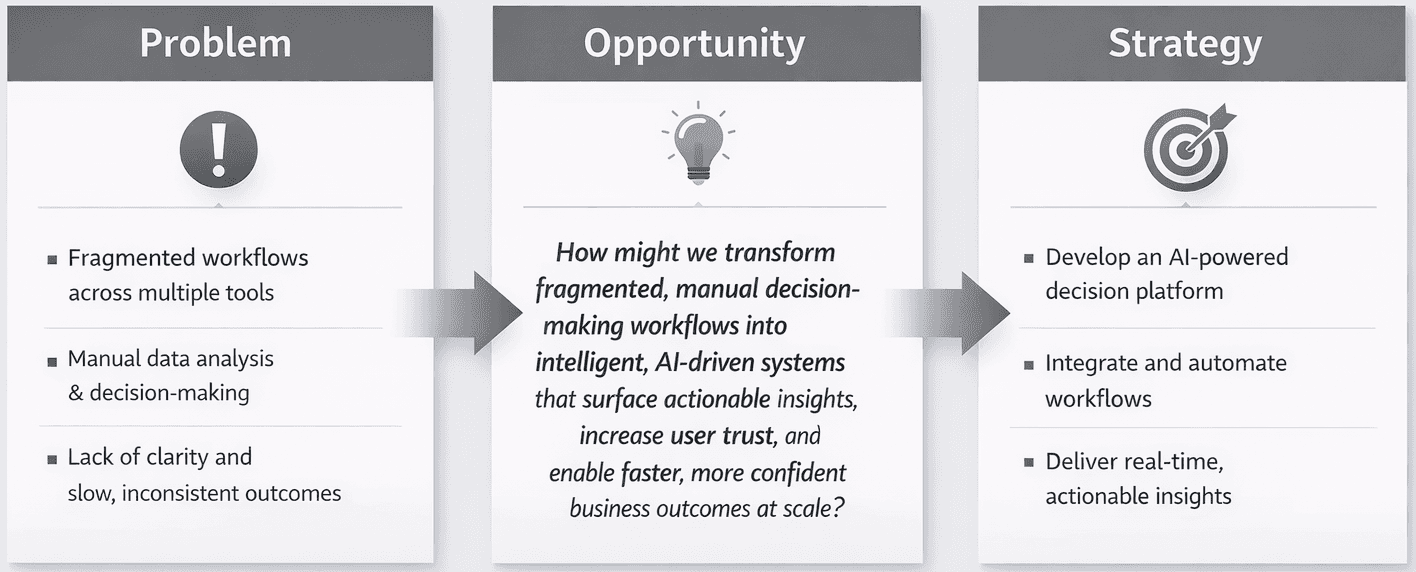
Reframing the right problem through Design Thinking Workshops to solve the "How might we…" statement.
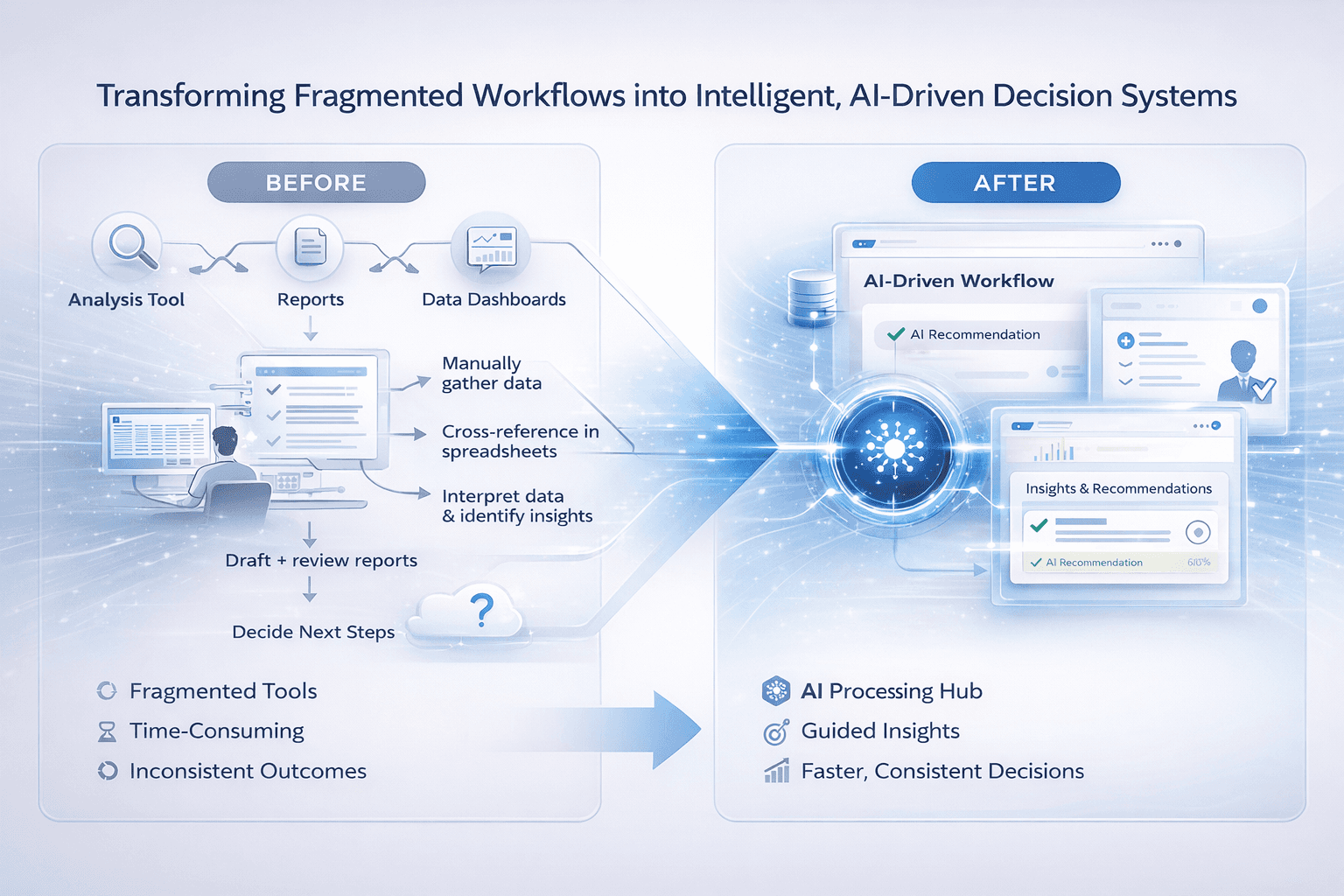
Storytelling Snapshot
The visual illustrates the "Before and After' workflow of the AI-driven insights platform. By integrating AI into key user journeys, we accelerated decision-making, increased trust in insights, and helped achieve meaningful business results.
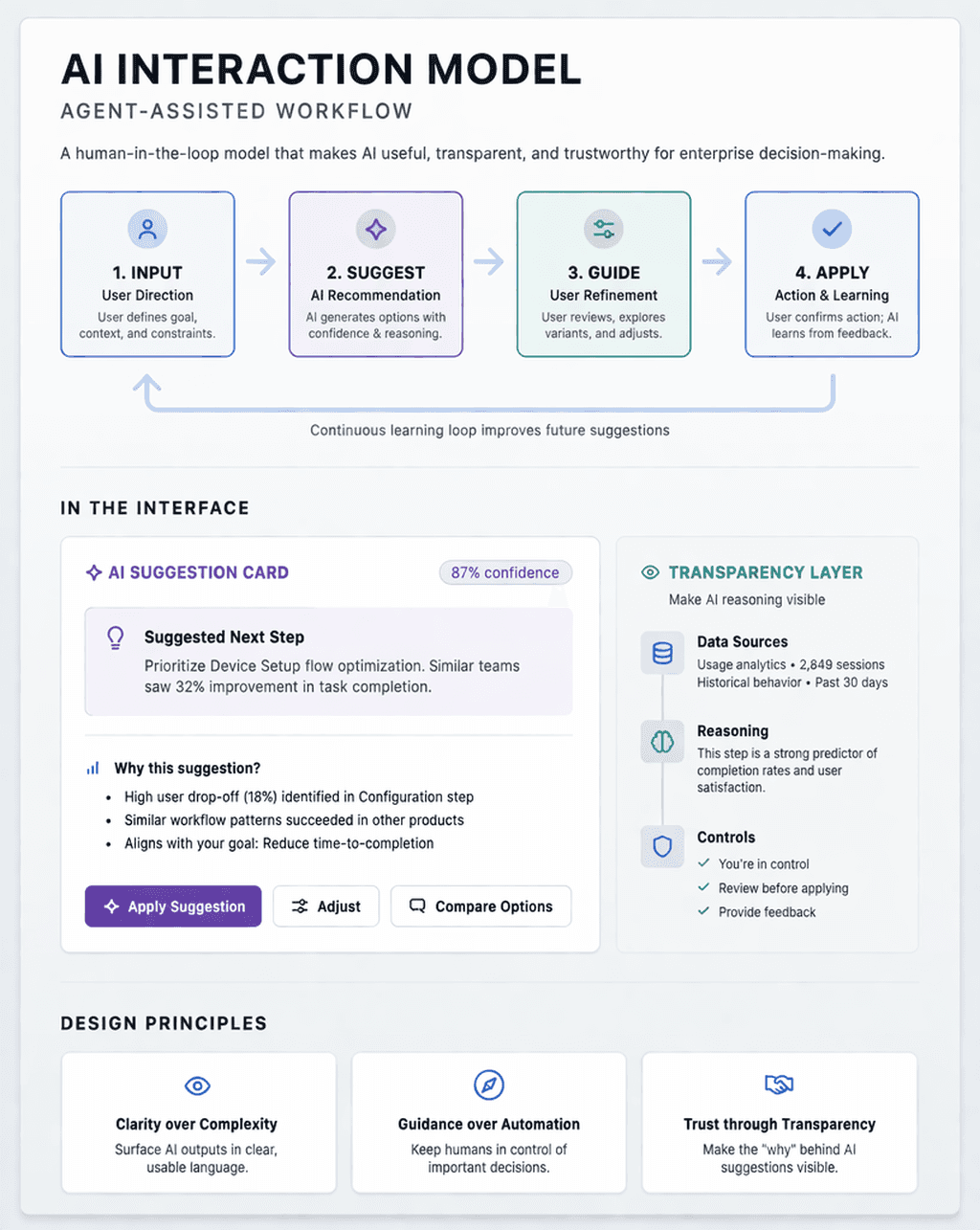
AI Interaction Model
The model turns complex data into valuable insights with a friendly human-in-the-loop system that offers helpful recommendations, explains its reasoning, and allows users to have control. By adding feedback options and clear transparency features, it fosters trust and keeps getting better at making good decisions over time.
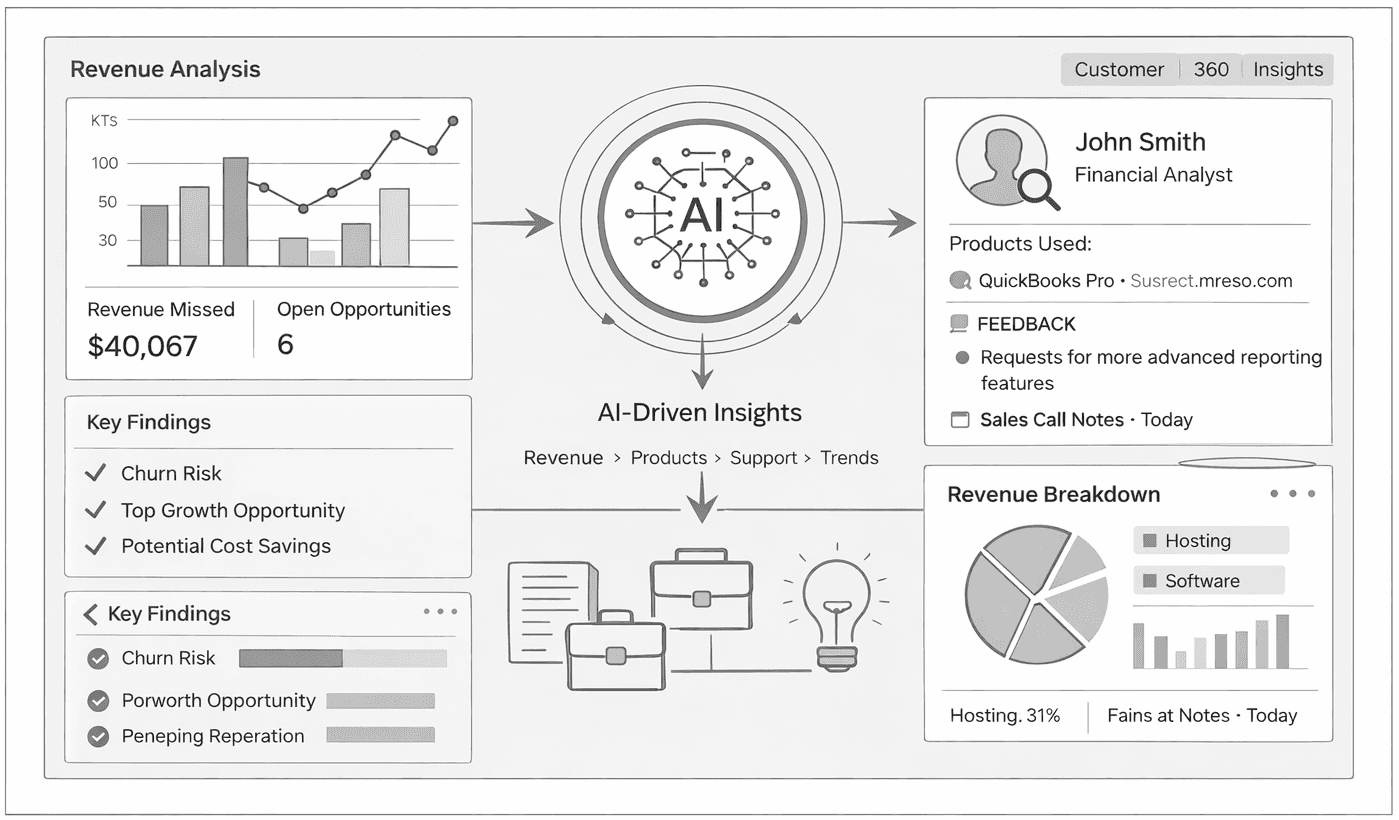
Design Exploration
The wireframe outlines a system-level experience that connects data, AI processing, and user workflows into a cohesive decision-making platform. It emphasizes structure, information hierarchy, and interaction flow to ensure clarity, scalability, and seamless integration of AI-driven insights.
Designing with AI
AI was thoughtfully integrated into the experience rather than a mysterious 'black box', making the product more engaging and transparent.
Key contributions:
Defined how users interact with AI recommendations in context
Designed feedback loops to improve model + user collaboration
Introduced explainability patterns to increase trust and adoption
Balanced automation with human-in-the-loop decision making
Reflection
Designing for AI isn’t just about the model—it’s about empowering better decisions. This project showcased how thoughtful design can influence not only user experience but also help teams successfully embrace AI.
As a design leader, my role extended beyond interface design to:
Defining product direction
Aligning cross-functional teams
Translating ambiguity into scalable systems
Copyright ©2026 Al Villanueva