

Summary
Role
Sr. Product Design Lead
I led the design of an AI-powered conversational experience that enabled users to interact with systems through natural language.
Product
Voice- and text-enabled conversational system fluent in financial language yet approachable, transparent, and capable of adapting to the client’s intent in real time.
Scope
Design of a conversational AI experience, working across product strategy, interaction design, and AI integration. My scope included defining the interaction model, establishing trust principles, and shaping how speech and language technologies (STT/TTS) were embedded into the product experience. I collaborated closely with Product, Engineering, and AI/ML teams to align on system capabilities, define scalable design patterns, and ensure the solution could be implemented across multiple use cases and platforms.
Timeline
8 weeks (including discovery, iteration, and alignment)
Team
• Client Leads
• AI/ML Engineers
• Data Scientist
Impact & Success Indicators
32%
increase in user trust and confidence in AI interactions
25%
improvement in task completion rate through conversational flows
20%
reduced onboarding time through guided conversations
• Established trust as a core design principle in conversational AI
Improved usability and accessibility through voice interaction
Enabled scalable conversational patterns across the platform
Increased adoption of AI-driven features
Key Decisions & Tradeoffs
• Prioritized clarity over conversational novelty to improve trust
Opted for guided conversations over open-ended AI responses to reduce ambiguity
Balanced automation with user control to prevent loss of confidence
Introduced explainability layers instead of simplifying outputs
Standardized conversational patterns for scalability across products
Background
As AI systems become more conversational, users increasingly rely on natural language interfaces to interact with complex products. However, these systems often fail to establish trust resulting in confusion, low adoption, and inconsistent user experiences. This initiative focused on designing a conversational system that users could understand, trust, and rely-on while integrating advanced AI capabilities such as speech recognition and natural language processing.
Challenge
The challenge was to build user trust in a system where users cannot see how decisions are made.
Key details:
• Low user trust in AI-generated responses
Inconsistent conversational experiences across touchpoints
Lack of clarity in how AI interprets and responds to input
Difficulty integrating speech interfaces into existing workflows
Balancing automation with user control
Approach
1. Problem Framing
“How do we make AI interactions trustworthy and understandable?”
2. User Research & Behavioral Insights
• Analyzed how users interpret AI responses
Identified trust gaps:
Lack of transparency
Unpredictable responses
Limited feedback mechanisms
3. Defining Trust Principles
Guidance over automation
Consistency builds confidence
Transparency over ambiguity
4. Iteration & Prototyping
Designed multiple conversational models
Tested:
Clarity of responses
User confidence
Error recovery flows
Solution
I designed a conversational AI system that:
Enables natural language interaction through Speech-to-Text (STT)
Delivers responses through Text-to-Speech (TTS) for accessibility and fluid interaction
Guides users through structured conversational flows
Established reusable patterns for integrating AI across multiple products
Key Deliverables
An AI assistant that recognizes intent, recall session context, and dynamically adjust its tone to match user sentiment. Transparency cues were embedded throughout the conversation, explaining data sources and decisions in clear language to reinforce trust.
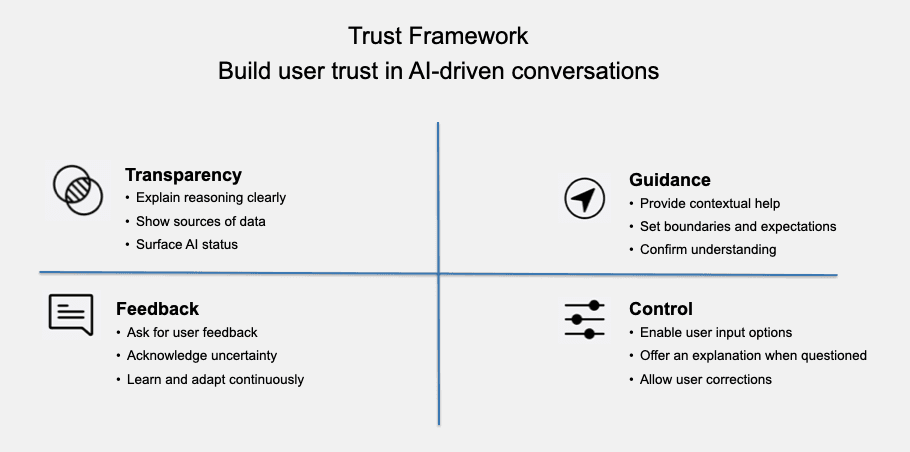
The Trust Framework
The framework defines how transparency, control, and feedback are integrated into AI interactions to build user confidence and enable reliable decision-making.
Designing with AI
The end product is an AI-powered conversational system at an enterprise-level platform with:
Integrated Speech-to-Text (STT) to capture natural user input in real time
Implemented Text-to-Speech (TTS) to deliver clear, accessible responses
Designed AI responses with explainability and context awareness
Created feedback loops to continuously improve conversational accuracy
Balanced automation with user control and intervention points
Reflection
This work demonstrated that successful conversational AI depends not just on language capabilities, but on designing transparency, control, and predictability into every interaction. By shifting the focus from conversation to trust, we created a foundation for scalable, human-centered AI experiences.
Copyright ©2026 Al Villanueva